If you’ve been following my weekly updates, you’ll notice that there are multiple ways to manage options positions that go against us. I wanted to share another example of how I managed a position in another account that I use in my options trading. This example illustrates the importance of keeping the position sizes relatively small.
On October 14th I opened a new position by selling 1 put contract on ARCT which was trading at about $21 a share. I sold a put with a strike price of $20 with an expiration of 11/21. I collected a premium of $510 for this trade. I knew the risk level was higher than normal, but I made my position size much smaller than usual because of this. On Wednesday of this week 10/22 the share price of ARCT dropped significantly. The share price went as low as $9.19 that day. Throughout the day the price was starting to come back up some, but still far below my $20 strike price.
To offset the loss I decided to purchase 500 shares at the lower share price and I bought the shares for a price of $10.83. This way if my $20 put gets assigned, which I expect will probably happen, I now hold $600 shares at an average share price of $12.36 per share. This way I should be able to sell calls on the shares at a strike price that is above my average cost per share. The share price ended this week at $11.22.
Another strategic thing about this adjustment is that the original put option that I sold was in my traditional IRA account and I bought the 500 shares in my Roth IRA. So even though I’ll possibly take a loss on the shares in my traditional IRA, that loss will be offset in my Roth IRA which I view as a type of tax free transfer of funds from my traditional IRA to my Roth IRA. I talk more about this strategy in the following article:
My next step will be to sell calls on the 500 shares that I own. Based on where the share price is right now I can sell calls with a strike price of $12.50 and an expiration of 11/21 and get $65 per contract or a total of $325 for 5 contracts. If the price goes above $12.50 by November 21st I would let the 5 call contracts assign. Then if my put gets assigned on 11/21 I can sell a call on those shares at a strike price of $12.50 or higher. I could also just sell the shares directly if the share price was above my average cost per share of $12.36.
Week 26 Results
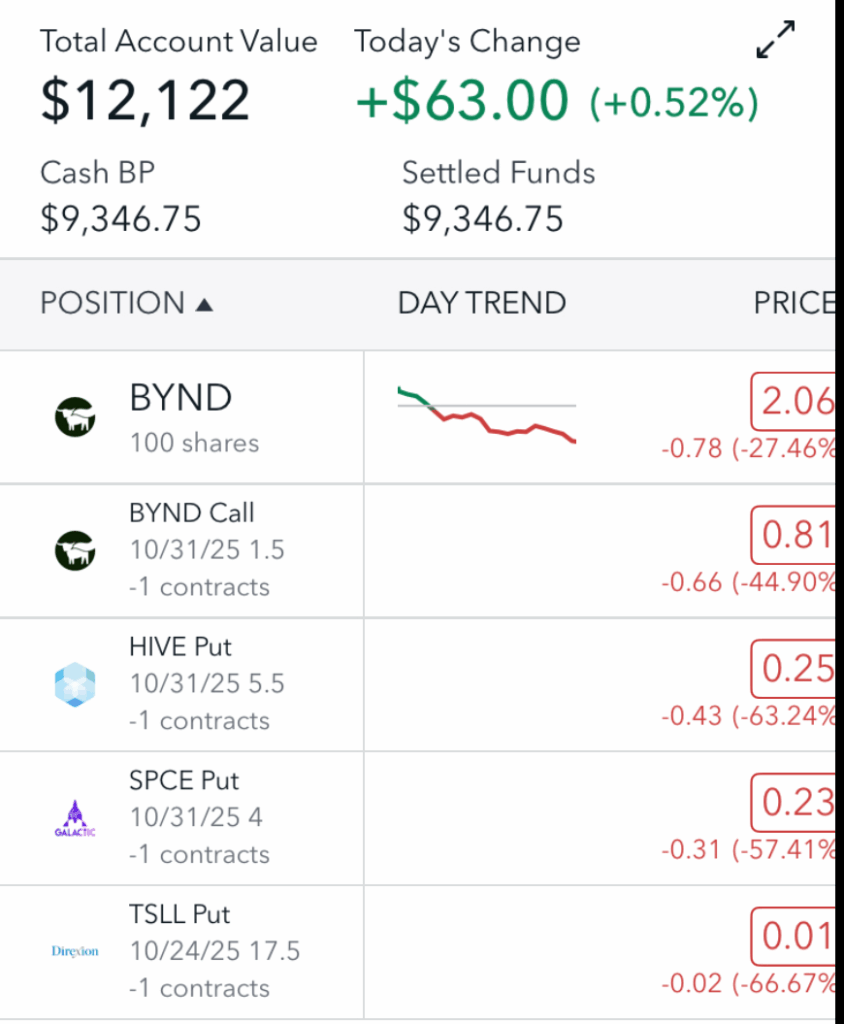
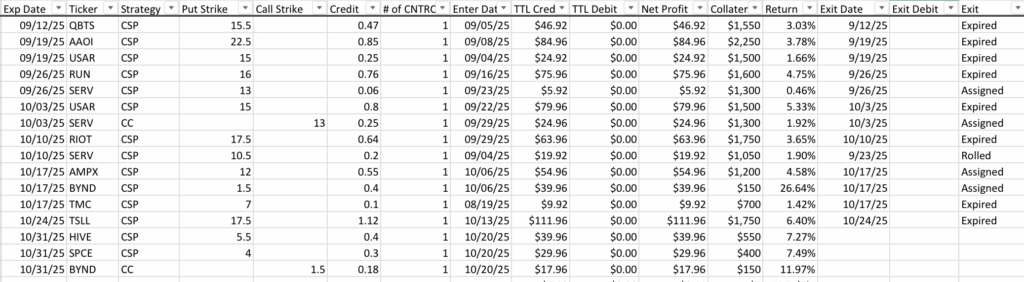
Well we’ve reached the end of week 26 or exactly 6 months into this journey. Up to this point things have gone relatively smoothly. We have had to make adjustments like rolling positions and getting assigned, but overall things are going along as expected. The only positions I started this week off with was a TSLL $17.50 strike put expiring 10/24 and 100 shares of BYND that I had gotten assigned on at $1.50 a share.
On Monday morning the share price of BYND was making a significant move up and when I looked at it the share price was around $1.10. So I opened a new position by selling a call on BYND with a strike price of $1.50 and expiration of 10/31 (11 DTE). For this I collected a premium of $18. In hindsight I should have waited a little longer because by the market close of the day the share price of BYND had gone up to $1.47. At some point on Wednesday morning the share price had skyrocketed to over $7 a share, but came down to end the week at $2.19 a share. It’s always easy to say we should have done a certain thing after it has happened, but all we can do is make a decision on trades based on where things are at in that moment.
I opened two other new positions on Monday. I sold a put on HIVE with a strike price of $5.50 and expiration of 10/31 (11 DTE). For this trade I collected $40 in premium. I sold a put on SPCE with a strike price of $4 and expiration of 10/31. I collected $30 for this trade. I was watching TSLL as Tesla was scheduled to report earnings on Wednesday. Here is a chart of my trades since the beginning of September:
Summary
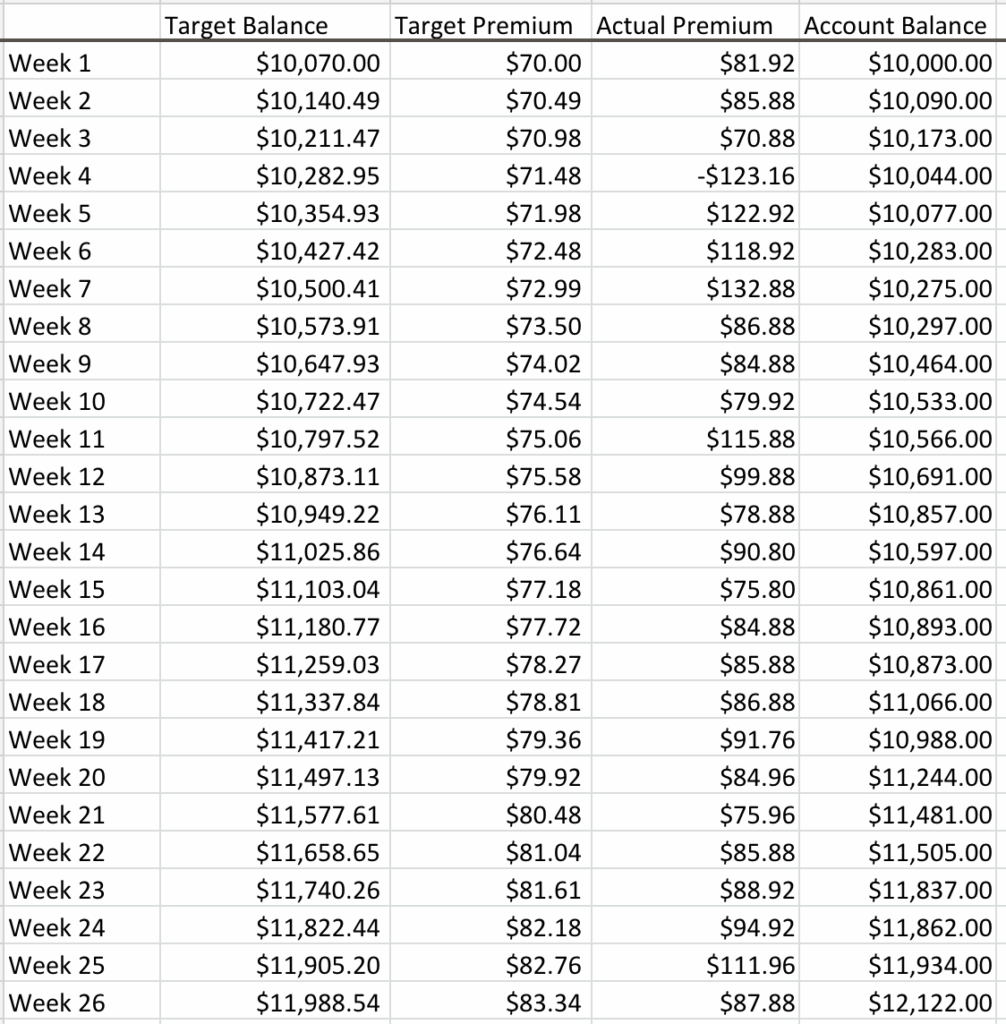
So for the week I collected a total of $87.88 in net premiums. My target for week 26 is $83.34. For the entire first 26 weeks I’ve collected a total of $2,183.04 in net premiums. My target for the first 26 weeks is $1,988.54.
I am in a good spot at this point in time as between the money I used to buy the BYND shares and the collateral for my open puts I’m only using $1,100 of my account which is much lower than usual. This puts me in a good place for when the next market downturn comes.
Here is a snapshot of my account positions as well as the summary for the first 26 weeks.