
No matter where you are in your investing journey, you have probably seen that starting the journey is one of the most difficult parts. A big reason for this is that in most cases, investors start with a relatively small amount of money. This can seem discouraging because the growth rate of the account seems slow when it only has a small amount of money to work with.
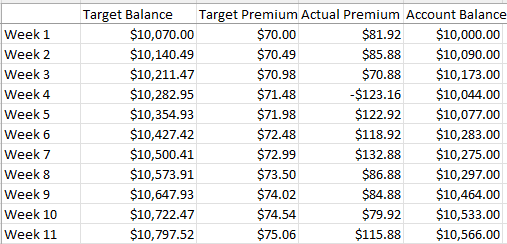
After 11 weeks into this journey of growing a $10,000 account, it may seem like it will take forever for the account to grow to a substantial amount. When we started, our target premium for the week was $70 and after 11 weeks, that target has grown to about $75.
It’s important to look at the big picture to see the results that the compounding effect will have over a longer period of time. If we look at a chart showing the growth based on our target over a 10 year period, you can see that the growth is fairly significant.
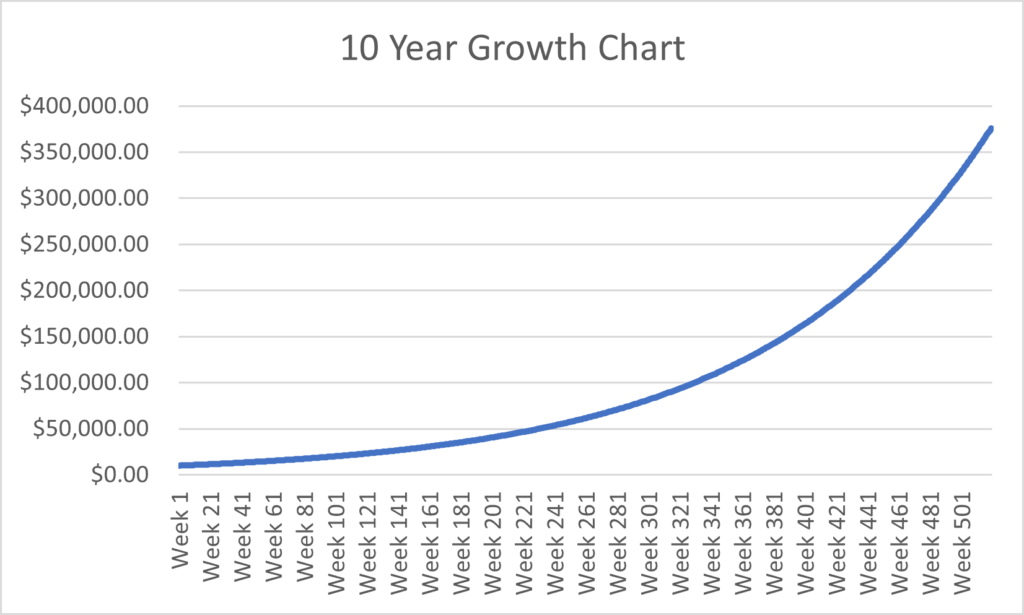
As you can see our target balance after 520 weeks or 10 years grows to be about $376,000. The growth is even more dramatic if we let it grow for another 10 years for a total of 20 years. From this chart you can see our target balance grows to be over 14 million dollars over a period of 20 years.
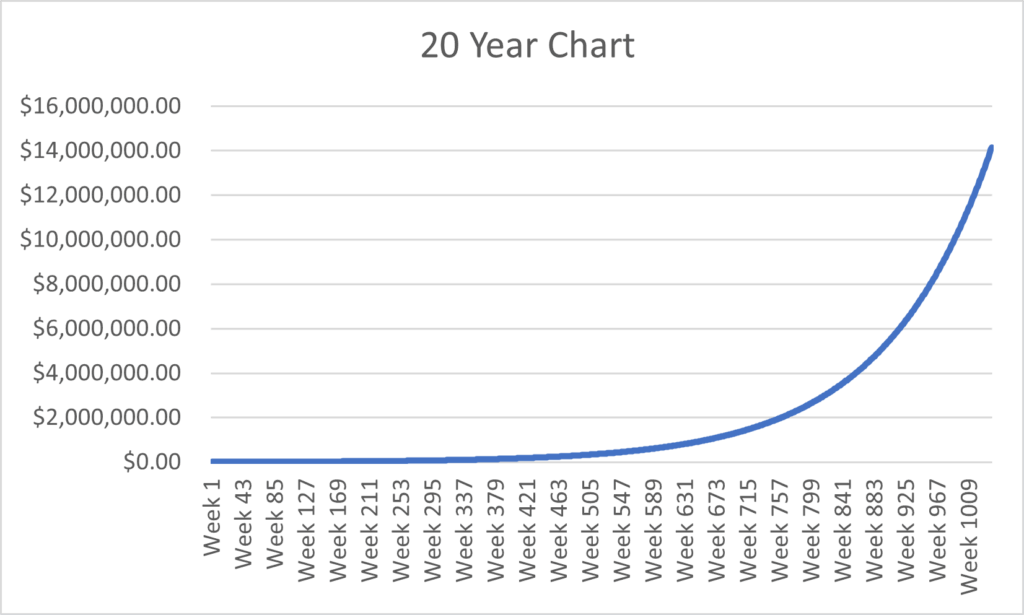
Of course the return on this strategy isn’t guaranteed and there are risks that can throw our progress off of what our target is. But the point is that even though the beginning may seem to be slow, as the gains compound over time, the growth is significant. If you had 14 million dollars you were using this same strategy on to generate 0.7% return per week, you’d be generating close to $100,000 a week in premiums.
Accelerating the Growth In the Early Stages
One way to accelerate the growth of your investment account in the beginning stages is to add money to it as you’re able. If you added $100 a week to your account from other earnings, that would greatly accelerate the growth. It would add more than what you’re making on premiums at least in the first year.
Week 11 Results
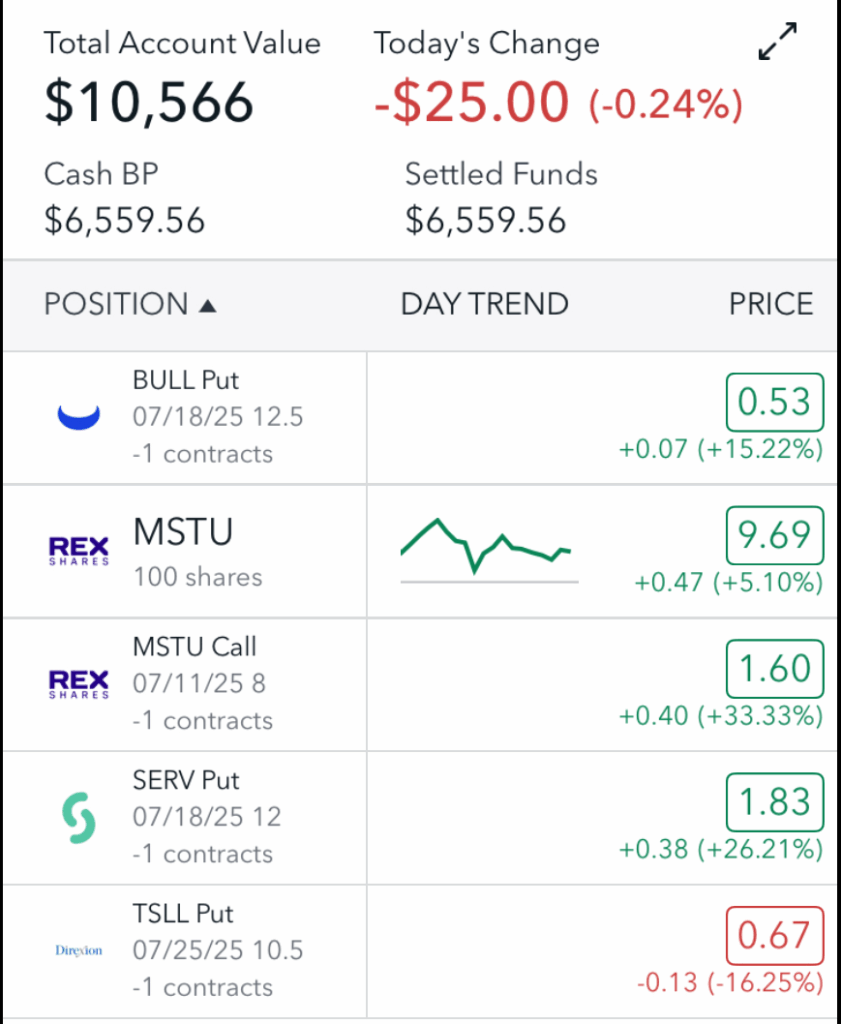
We started the week out on Monday holding 100 shares of MSTU that we had been assigned on. We also had the following open option positions:

The price of MSTU had risen a good amount above the strike price of the call so I planned on just letting that assign if the price stayed above $8 at the end of the week. The price of TSLL dropped a significant amount on Monday, but I decided to see how the week went and roll if needed. I opened a new position by selling a put on BULL with a strike price of $12.50 and an expiration of 7/18 (11 DTE). For this I was able to collect a premium of $81.
Some people ask what delta I shoot for when choosing my strike price. In most cases, I’ll choose a fairly high delta. I’ll usually go with a delta of around -0.40 to -0.45. I know that most options traders choose lower deltas which lowers the risk of having to manage the positions. My thought on it is that if I choose a lower delta, I end up getting a lower premium and to reach my target weekly premium I end up having to use a higher percentage of my capital to reach my target. This raises the risk that I would run out of available capital to work with sooner when the market goes into a downturn.
When Wednesday came along, the share price of TSLL was still lagging. At this point I had to decide if I wanted to roll it to avoid the risk of possibly getting assigned early, or just wait until Friday to see if the share price would recover to be above my strike price. I chose to roll the position out two weeks and roll the strike price down to $10.50 from $11. So I rolled it to a 7/25 expiration date. I was able to collect $35 as a net credit for the roll.
When Friday came, I realized that I should have just left the TSLL put to expire as the share price did recover and ended above $11. But I was able to collect additional premium for the roll. MSTU ended up a comfortable amount above my call strike price so I was able to let the call assign and sell the shares at the same price I bought them for. Here is a chart of the activity for the week:

Summary
So for the week between my BULL put and rolling my TSLL put I was able to bring in a net credit of $115.88 for the week The total net premiums received for the first 11 weeks is $857.80 and our target for premiums up to this point is $797.52. So we’ve got some cushion to work with up to this point. Based on the premiums received so far, our return is about 8.58% for the first 11 weeks.
Read: How to Generate Consistent Returns Through Options Trading